I came across this post recently on the subject of bronies, male fans of My Little Pony. This is my lack of Tumblr knowledge showing, but I find it hard to parse exactly who said what in that conversation, so I'll sum up the whole thing (and trigger warnings for sexual assault in a situation that involves the potential for that, though it doesn't happen):
The original poster is relating the events of a My Little Pony Convention, where she met an 11 year old girl full of MLP enthusiasm. The same girl came to her the next day, scared, because she was being stalked by an older male brony who was trying to get her alone in his hotel room. The poster and her friend rallied around the girl, hid her, and pushed the brony away for the rest of the convention. And she concludes that she's angry she is that this space for kids was being turned into something gross and sexual and entirely about the bronies involved. And she is absolutely right; that's absolutely gross and wrong.
The responses start there, mostly involving a debate over whether the poster should have gone to the police, and whether any good would have come out of that. The general consensus is that both the convention holders and the police would be very reluctant to take any action until something outright criminal occurs, which is incredibly depressing and probably accurate. What I wanted to emphasize, though, is the first sentence of the last paragraph: "I’m going to lay it on the line here: If you identify as a Brony and you do NOT call out this behavior when you see it, you are a piece of shit. ... You’re a dude who likes MLP? That’s awesome! I hope you get much joy of it. But if that joy comes at the harm and expense of little kids then fuck you. Seriously."
So in light of that, it's time to talk about what My Little Pony means to me, and what responsibilities that gives me.
First: I totally get the obvious objection, that the whole point here is that an unwanted group is taking a show affiliated with a fandom and warping it all to be about them, and by centering this discussion on what MLP means to me I'm doing the same thing. I can only ask that you hear me out; this post is about working through what the show means to me in order to build for myself how I can support it. With that proviso...
A lot of the specifics here don't apply to me exactly. I *like* MLP, in the sense that I'll go out of my way to watch it, and there's a lot it does that I'm a big fan of, which I'll probably get into later. But I don't consider myself a brony, on the basis that the concept of brony has become so toxic to me that I want to go out of my way to avoid that label and because I'd never go to a convention for it, both because my level of fandom isn't quite that high and because I don't like going to conventions in general; whenever there's a situation where there's a large number of people I don't know and my own role in that group is undefined, unless I have a very compelling reason to attend, I'd rather stay home. My anxiety issues don't handle crowds well. (The difference, in case you were wondering, between that and a conference situation is that at a conference, my role is defined, especially if I'm giving a paper.)
And all of that is equivocating nonsense. The issue here isn't to measure exactly what kind of fan I am. The issue is whether I'm willing to stand against those who would warp MLP into something that comes at the extent and harm of an audience that can't defend itself. In the past, I've deliberately avoided the brony question because I didn't want to get involved; I thought if I avoided putting a clear label on my own interest on the show, I could get away with just enjoying the show on my own terms. Well, as I've said elsewhere online today, escapism is a political statement, and a choice in itself. Saying I'm just here to enjoy myself and not hurt anyone stops being enough when people who do want to hurt someone show up. The tl;dr version of this post is that I want to be someone who would stand against the people described in that tumblr, and I want the writing of this post to be a first step towards that.
I think the sexualization of MLP characters is absolutely gross because it's alienating to an audience that shouldn't have to worry about that, and it's so antithetical to what the show is about. As for what it is about, that's not hard--it's right there in the show's subtitle, "Friendship is magic." It is a show about six friends with very different personalities and interests, and how they stay friends both in spite of and because of those differences. At its best, it stays true to those characters and those friendships above all else, and that's what I personally find appealing about it. That it does so with humor and long-term world building, that it's presenting these characters to young girls who are bombarded with media messages about how they should be competing in terms of looks and shunning those who are different, that, for the most part, it respects those fans and doesn't talk down to them---all of that is icing on the friendship cake, as far as I'm concerned. (That "talking down" point is a little iffy; in the early seasons especially the episodes tended to end with the lead character literally writing a letter that told what lesson she learned from the episode. But hey, it's miles ahead of the "The More You Know" GI Joe thing.)
It's important to me that I make clear that watching MLP is not a blip in my personal media history. As a kid, I read a lot of Babysitter Club books. When I got older, it was Judy Blume. And older than that, I spent a summer reading the works of Maeve Binchy. Usually, whenever I tell anyone that, I add that it was because I'd ran out of sci-fi and fantasy books in my local rural library. And that's a lie, or at the very least, a sin of omission, and one with a sexist core. It was something I said because I didn't want people to think I read "girly" books because I actually enjoyed them. (And, if we're going for total honesty, as a teenage hetero male, books about female desire was kind of a turn on.) For most of my childhood, I felt like reading itself was considered an un-masculine past time--I had wonderfully supportive teachers, but to my own peers, books--and any level of effort in school in general, beyond the bare minimum--were weird and uncool. And being caught with the latest Ann M. Martin was just going to make things worse for me. That doesn't excuse not owning up to it in the past decade, though; my only excuse is that a childhood is a hard thing to put behind you, as my collections of dreams in any particular week could attest.
I've also been a fan of certain TV shows that unfold on similar lines: Gilmore Girls, Nashville, Gossip Girl. I have a very, very high standard for rom-coms, but when I find one I like, I'll praise it for ages, like My Best Friend's Wedding or Fever Pitch (okay, high but eccentric standard). The first 30 minutes of Frozen rocked my world. Spider-Man Loves Mary Jane was one of my favorite titles Marvel ever published. What all of these things have in common are, for me, the reason why I turned to those "girlie" books to get something that the YA sci-fi of Heinlein or Hitchhiker's Guide to the Galaxy just weren't supplying for me: emotional depth. A large portion of Western fiction is centered around action, around characters who are trying to get something accomplished above all else. These other stories that attracted (and attract) me aren't about that, not primarily; they're more about just being. They're stories that recognize that people are filled with these strange, overwhelming impulses, and they focus more on how we can relate to those impulses and relate to others through them. And that mattered to me. It's not that the other stories don't do that--Dan Harmon's shows, Community, and Rick & Morty, are both examples of shows that tend more towards zany meta-narratives, but also keep a core of emotion to them. (His big complaint about rom-coms, incidentally, is basically the inverse of this, that they're all the emotion part with no discernible action.) But so much of Western masculinity seems to be tied up in hiding the fact that we're all dealing with this inner turmoil. Shows that are overtly about characters working their way through these emotions, trying to become better people in the process--all that matters to me.
Granted, it's not something I'd want to watch exclusively, or read exclusively; heart-wrenching can become over-wrenched, with too much exposure, and this type of story can lend itself to melodrama very quickly (I'm looking at you, The Notebook). But experiencing media where people openly struggle with their own inner depths appeals to me--and, this probably goes without saying, gives me impetus to express my own. Now, I'm not saying every episode of MLP is a deep journey into the inner psyches of magical horses. But it certainly isn't a show about a positive set of role models from young girls and turning them into sex fantasies. Rather, it is a show about how friends can explore who they want to be in the comfort of other friends. And I want to defend the right of those who aren't in a position to defend themselves to be able to do the same. I don't know if this post is a step towards that, but it is a step towards me realizing that I have a responsibility to do so.
Later Days.
Showing posts with label tv shows. Show all posts
Showing posts with label tv shows. Show all posts
Thursday, April 24, 2014

Monday, January 20, 2014
Space: The Old Frontier
If you ask people what their favorite Trek is, the odds are you'll get an answer based on age. Those who were around for the original series speak confidently about being around when it all started. Those who were teenagers in the 90s speak enthusiastically about Next Generation, and how it modernized everything into a sleek new appeal. Those born a few years later will defend Voyager (although generally, what they're actually defending is "hey, that Borg chick was hot, and the hologram doctor was cool). And I'm sure there's a generation now who will defend nuTrek as being the most exciting of all possible worlds.
No one defends Enterprise. No one.
But for my money, my favorite is always the black sheep of the group, Deep Space Nine. Yes, okay, it was riffing off, if not ripping off, Babylon Five. And yes, it was dark, in tone and in lighting. (Cardassians apparently are not the most gregarious of interior decorators.) But it had and has so much in its favor. First, it's still the only Trek that stayed in one place. Arguably, that's a point against it: exploration is ingrained as a Trek element ever since a certain ship set out on its five year mission. But being stationary meant that it could explore the cultures of the races around it much more.(Plus, from a fancy scholar perspective, there's a lot troubling about a civilization that has its roots in Western culture going around on a never-ending colonial expansion quest.) Yes, we still had episodes about the culture of the week, but there was a lot more chance to get really deep into the established cultures: Cardassian, Bajoran, Dominion, and even Ferengi. After DS9, there was depth to the Ferengi culture. That still seems like it should have been impossible.
Going back way back, I once set up some criteria for what I look for in a show: good set pieces, a long term plot, character development, dialogue, and characters. Dialogue is probably the weak point for DS9; not that it's bad, it's just that it can be hit or miss. It has some great one liners and great scenes, but also some real clunkers. This is the fate of a show with a lot of different writers. In terms of set pieces, there are some really appealing episodes; comedy-wise, the time-travelling "Trials and Tribble-ations" is a great salute to the original series. And "In the Pale Moonlight" is a wonderful take-down of Star Trek optimism for something more complex and sinister. Character-wise, it's an ensemble cast down to its core, with traditional Starfleet types (Bashir, the bright-eyed doctor, Dax, the cheery second-in-command, the workmanship of O'Brien, and and the brash captain style of Sisko) clashing with the more jaded world views of the revolutionist Kira, the isolated Odo, the cheerful skullduggery of Garak, and the scheming Quark. As for character development, I make fun of Voyager a lot, but the one thing it did absolutely right is center the later seasons around Seven of Nine's growth towards humanity, and the earlier seasons around the Doctor's experience of the same. The other characters are kind of splotchy--Kim, Paris, B'Lanna, Janeway, Chekotay sort of reach a certain point, and remain static. DS9, on the other hand, puts all of its characters on a trajectory, and you can see how their relationships and their selves evolve over time. And that leaves its high point, plot. More than any other Trek, Deep Space Nine kept its continuity. The war with the Dominion, its big overarching plot, lasted for whole seasons, and really gave a sense that something was going on that affected the entire universe. And you need to remember, this is the 90s--before DVR, Netflix, and streaming, networks were basically disincentivized to do dramas with continuity; if viewers missed an episode, the only possibility was to wait and hope it randomly showed up in the reruns. So for the long-form show to even exist, there had to be a struggle. (Which probably explains why Voyager adopted a more episodic approach.) That DS9 tried for that struggle, and succeeded to the degree it did, matters. It paved the way for later continuity-heavy sci-fi, such as Battlestar Galactica (not least because Ron Moore was one of the writers hired for later DS9 episodes).
But if I argued that my attachment to the show was entirely objective or historical, I'd be lying. It mattered to me. It matters to me. Basically, I watched the show through twice. The first time, I was in high school. I had spent most of my youth being culturally deprived, as my parents didn't have cable. (That mattered! I had a lot of strikes against me as a kid--not being able to relate to the shows the cool kids were talking about did not help! Although if I hadn't resorted to teh books instead, who knows where I'd be now.) So it was a big deal when my father the teacher gave me permission to use the elementary school's cable to tape whatever I wanted. I kind of went nuts with it; I remember spending long sessions staring at the TV guide, trying to decipher which channels on the elementary school TV corresponded to which stations in the book. It must have been season 5 or so before I caught on to the tail end of DS9 in my TV trawling, but I remember being hooked right away. Until then, I had been a STNG type--DS9 was too slow, and too political for my tastes. But the teenage brain was just in the right place for it, and thus, hooked. My brothers couldn't stand the show--they would watch Voyager with me, but didn't see why DS9 was worth taping. And we had only a single 8 hour cassette to capture a week's worth of television, so there were actually arguments over whether it deserved its place in the line-up.
And that's my interest in media culture--endlessly fascinating how we adapt something like the limitations of a 8 hr VHS tape into our lives.
The second time I watched through the series, it was in reruns. It was during the summer of 2002, which was... not a pleasant time in my life. Academically, I was still in full over-achiever mode, so that was fine. But socially, I was pretty much a disaster. I had made zero close friends in my first year of university, and I was literally spending the summer living unemployed in my parents' basement. Not a high point. The only interesting things that ever happened to me personally for four months were volunteer jobs at the local library and senior centers--which were educational in their own way, I guess. Deep Space Nine was the show on every week day at 2:00 pm--the last show, essentially, that I could watch before my family came home, and I no longer had the freedom of being alone. I want to emphasize at this point that my family has never been less than totally supportive of me--it was just my mindset at the time that any other human presence served to remind me that I was falling below my own impossible standards of success. And it mattered, then, that the last piece of my daily solitude was spending an hour with a bunch of oddballs who managed to get their shit together every week to keep the space trains running on time.
I'm bringing all of this up now because I'm currently reading my way through the AV Club reviews of Deep Space Nine. I've reached third season, and I came across this passage: "There’s a great scene early in the hour when Kira brings by a plant as a house-warming gift, and Odo, after initially not wanting to let her inside his new apartment, tells her excitedly about all his plans to try new shapes and new textures. It’s a sweet exchange between the two of them, but it also shows just how vulnerable and lonely Odo really is. He isn’t a cynic at heart; he wants to engage with life, he’s just terrified of risking a sense of self." I read that, and I felt such a pang of sympathy for Odo--and for my past self, remembering me watching that scene.
Hang in there, Odo-me. It gets better.
Later Days.
No one defends Enterprise. No one.
But for my money, my favorite is always the black sheep of the group, Deep Space Nine. Yes, okay, it was riffing off, if not ripping off, Babylon Five. And yes, it was dark, in tone and in lighting. (Cardassians apparently are not the most gregarious of interior decorators.) But it had and has so much in its favor. First, it's still the only Trek that stayed in one place. Arguably, that's a point against it: exploration is ingrained as a Trek element ever since a certain ship set out on its five year mission. But being stationary meant that it could explore the cultures of the races around it much more.(Plus, from a fancy scholar perspective, there's a lot troubling about a civilization that has its roots in Western culture going around on a never-ending colonial expansion quest.) Yes, we still had episodes about the culture of the week, but there was a lot more chance to get really deep into the established cultures: Cardassian, Bajoran, Dominion, and even Ferengi. After DS9, there was depth to the Ferengi culture. That still seems like it should have been impossible.
Going back way back, I once set up some criteria for what I look for in a show: good set pieces, a long term plot, character development, dialogue, and characters. Dialogue is probably the weak point for DS9; not that it's bad, it's just that it can be hit or miss. It has some great one liners and great scenes, but also some real clunkers. This is the fate of a show with a lot of different writers. In terms of set pieces, there are some really appealing episodes; comedy-wise, the time-travelling "Trials and Tribble-ations" is a great salute to the original series. And "In the Pale Moonlight" is a wonderful take-down of Star Trek optimism for something more complex and sinister. Character-wise, it's an ensemble cast down to its core, with traditional Starfleet types (Bashir, the bright-eyed doctor, Dax, the cheery second-in-command, the workmanship of O'Brien, and and the brash captain style of Sisko) clashing with the more jaded world views of the revolutionist Kira, the isolated Odo, the cheerful skullduggery of Garak, and the scheming Quark. As for character development, I make fun of Voyager a lot, but the one thing it did absolutely right is center the later seasons around Seven of Nine's growth towards humanity, and the earlier seasons around the Doctor's experience of the same. The other characters are kind of splotchy--Kim, Paris, B'Lanna, Janeway, Chekotay sort of reach a certain point, and remain static. DS9, on the other hand, puts all of its characters on a trajectory, and you can see how their relationships and their selves evolve over time. And that leaves its high point, plot. More than any other Trek, Deep Space Nine kept its continuity. The war with the Dominion, its big overarching plot, lasted for whole seasons, and really gave a sense that something was going on that affected the entire universe. And you need to remember, this is the 90s--before DVR, Netflix, and streaming, networks were basically disincentivized to do dramas with continuity; if viewers missed an episode, the only possibility was to wait and hope it randomly showed up in the reruns. So for the long-form show to even exist, there had to be a struggle. (Which probably explains why Voyager adopted a more episodic approach.) That DS9 tried for that struggle, and succeeded to the degree it did, matters. It paved the way for later continuity-heavy sci-fi, such as Battlestar Galactica (not least because Ron Moore was one of the writers hired for later DS9 episodes).
But if I argued that my attachment to the show was entirely objective or historical, I'd be lying. It mattered to me. It matters to me. Basically, I watched the show through twice. The first time, I was in high school. I had spent most of my youth being culturally deprived, as my parents didn't have cable. (That mattered! I had a lot of strikes against me as a kid--not being able to relate to the shows the cool kids were talking about did not help! Although if I hadn't resorted to teh books instead, who knows where I'd be now.) So it was a big deal when my father the teacher gave me permission to use the elementary school's cable to tape whatever I wanted. I kind of went nuts with it; I remember spending long sessions staring at the TV guide, trying to decipher which channels on the elementary school TV corresponded to which stations in the book. It must have been season 5 or so before I caught on to the tail end of DS9 in my TV trawling, but I remember being hooked right away. Until then, I had been a STNG type--DS9 was too slow, and too political for my tastes. But the teenage brain was just in the right place for it, and thus, hooked. My brothers couldn't stand the show--they would watch Voyager with me, but didn't see why DS9 was worth taping. And we had only a single 8 hour cassette to capture a week's worth of television, so there were actually arguments over whether it deserved its place in the line-up.
And that's my interest in media culture--endlessly fascinating how we adapt something like the limitations of a 8 hr VHS tape into our lives.
The second time I watched through the series, it was in reruns. It was during the summer of 2002, which was... not a pleasant time in my life. Academically, I was still in full over-achiever mode, so that was fine. But socially, I was pretty much a disaster. I had made zero close friends in my first year of university, and I was literally spending the summer living unemployed in my parents' basement. Not a high point. The only interesting things that ever happened to me personally for four months were volunteer jobs at the local library and senior centers--which were educational in their own way, I guess. Deep Space Nine was the show on every week day at 2:00 pm--the last show, essentially, that I could watch before my family came home, and I no longer had the freedom of being alone. I want to emphasize at this point that my family has never been less than totally supportive of me--it was just my mindset at the time that any other human presence served to remind me that I was falling below my own impossible standards of success. And it mattered, then, that the last piece of my daily solitude was spending an hour with a bunch of oddballs who managed to get their shit together every week to keep the space trains running on time.
I'm bringing all of this up now because I'm currently reading my way through the AV Club reviews of Deep Space Nine. I've reached third season, and I came across this passage: "There’s a great scene early in the hour when Kira brings by a plant as a house-warming gift, and Odo, after initially not wanting to let her inside his new apartment, tells her excitedly about all his plans to try new shapes and new textures. It’s a sweet exchange between the two of them, but it also shows just how vulnerable and lonely Odo really is. He isn’t a cynic at heart; he wants to engage with life, he’s just terrified of risking a sense of self." I read that, and I felt such a pang of sympathy for Odo--and for my past self, remembering me watching that scene.
Hang in there, Odo-me. It gets better.
Later Days.
Monday, September 30, 2013
TV Buff: Nazis, demon possession, and alien abduction, all in one handy place in American Horror Story: Asylum
I splurged, and went through all of
American Horror Story: Asylum last week. Thoughts on how that
went, after the break. Spoilers, although I'm somewhat forgiven,
given that the show ended months ago.
So looking back on the blog archives, I see that I never quite got around to posting what I thought about the first season of American Horror Story. I did, however, quote its best scene, so that's something, at least. What that means at the moment, though, is that I need to give some account of the series' premise. The operating idea here is that it's an anthology series, but one not where every episode is a new thing like Twilight Zone, but one where ever season starts afresh, with a new roster of characters (though not necessarily an entirely new cast). The first season revolved around a haunted house and a number of related ghost stories: the murdered other woman, a high school shooting, a hidden early 20th century home abortion clinic, and a lovers' quarrel turned fatal. It had a surprisingly dark ending (for TV, if not for the subject matter), which was either brilliantly countered or horribly spoiled, depending on who you ask, by a saccharine coda.
But what I find so appealing about the series is the concept. Horror--with the possible exception of video games--has been dominated by the short form, in short story and in film. To be able to explore multiple, simultaneous conventions of horror in a sustained manner is a luxury that TV can offer, and, almost devoid of whether it's any good or not, I'm glad such a thing exists. (That's not entirely true; I once said I'd like any sort of ongoing musical series on television, and then Glee proved that statement to be a liar.) Luckily for me, then, American Horror Story: Asylum is good.
The title pretty much gives away the subject matter here. The story takes place in Briarcliff Mental Institution in 1964, a place run by Sister Jude (Jessica Lange), whose philosophy is start with the rod and you never have to worry about spoiling; and Dr. Arthur Arden (James Cromwell), a man who believes that it's pretty much okay to experiment on these "Darwinian rejects"; that women are either unrelenting sluts who need to be taught a lesson or untouchable saints; and may also be a Nazi. Fun guy. There's also Monsignor Timothy Howard, the ambitious father who founded the institution and hopes to use Arden and Jude's efforts there to further his own career. Most of the show takes place in the institution in the past, and it's here we meet the core cast of inmates: Grace Betrand (Lizzie Brochere) who is an alleged murderer; Kit Walker (Evan Peters), who is thought to be the murderer Bloodyface, but claims his wife was actually kidnapped by aliens; and Lana Winters, a reporter who came looking for a story on Murderface, and winds up an inmate. An episode or two in, we also get Zachary Qunto as Dr. Oliver Thredson, there to assess Walker's sanity. Many stories also start with a scene in present day, where someone claiming to be Murderface chases after victims in slasher-esque vignettes. Lana's story is especially chilling: she goes in looking for a story about Bloodyface, but when she threatens to expose the mistreatments at Briarcliff, Sister Jude has her committed as insane for being a lesbian, using her girlfriend's fear of exposure as a pressure point to get her to sign the papers.
Like the first season, Asylum intertwines a number of different plot lines. Sister Jude slowly loses control of the asylum to Arden and Sister Mary Eunice, her demon-possessed protege. Eventually, her attempts to fight back reach such a failure that she is committed in her own asylum, and driven mad herself through a combination of electroshock and pills. Lizzie and Kit avoid forced sterilizations after being, uh, rescued by aliens. Arden becomes increasingly disillusioned with Sister Mary Eunice and himself until he meets with a suitably Pyrrhic ending. And Lana finally escapes Sister Jude and Arden's monsters only to run afoul of the actual Bloodyface, going from asylum to murder dungeon. A lot happens in thirteen episodes.
Asylum is lacking a bit of the real world punch that comes with the first season of AHS. For me, the show is at its best when it's juxtaposing real life horror with fantasy horror, and implicitly demonstrating how we use the latter to avoid facing the former. For AHS season one, that's most clear in the episodes featuring the high school shooting. Juxtaposing the shooting with ghost stories and other horror-filled stories really drove home the connection for me that this show is about what we are afraid of. Asylum's setting means it doesn't have the same immediacy; a lot of the real-world horror, such as the ability to commit people to asylums for being gay, or the social stigma on mixed marriages, is easier to dismiss with a "we're past that now" sort of mindset. The present sequences could be seen as a response to that, but like I said, they're really more a slasher pastiche than anything else. Which is fun, but not much more than that (maybe a comment on nature vs. nurture, and the foster care system).
There's also the issue that, for me, the whole alien plotline didn't really work. I'll admit that alien abduction is the sort of urban legend that should play well to AHS, but it falls flat. I think the aliens were never really portrayed as horrific--just sort of unearthly. You could argue that they were never meant to be horrific, but then the resolution of Kitt and Lizzie's story really falls flat. (Which it kind of does either way. It's really a dumb sort of resolution.) It would have been easy for the demon-possession plot to go the same way, but it’s saved by two things: the stellar performances of Cromwell and Lily Rabe; and the appearance of the Angel of Death, who adds a whole new level of creepiness to the show when she starts appearing in front of characters near death.
Where it really shines this season, though, is in the depiction of authority, and its involvement in mental health. Many of these patients are only there because someone else in a position of authority--Sister Jude, Dr Arden, Dr. Thredson--has the authority to say that they belong there. As Thredson points out, that's often authority over life and death. And when this power is placed in the hands of people with their own petty agendas and grievances, the abuses can be terrifying. In that sense, it's similar to the power relations in Orange is The New Black. The added wrinkle is that the series directly confronts the very real fear that people have over mental issues, the fear that what we can't trust our own perceptions, and the stigma that we place on those that we mark as other because they fall on a different side of our insane/sane line in the sand. As that previous quotation should convey, one of the most terrible things in AHS is where the wife's husband uses his authority as a doctor to get her committed. The entire season of AHS: Asylum is about that sort of power abuse.
While the story falls flat in places, the acting almost always is enough to keep you going. Jude, Arden, and Thredson in particular have just the right balance of menace and aloofness to carry their roles past little gaps in logic. In the end, though, a lot of your feelings for the season will depend on how much sympathy you can muster for Sister Jude's character, whether she's a good person who went too far trying to instill order after putting her life back together, or whether she’s a hubristic monster who gets what’s coming to her in a system she created—or a bit of both. I think I fall a little too far on the former side. But her character examination in juxtaposition with Lana’s is ultimately the center of the season. Tragedy is very similar to horror, in that both involve a sharp deviation from what we’re conditioned, societally, to consider as the appropriate consequence of a series of events. Both are about what happens when things go wrong, and the punishment of transgressions. The difference between the two, I think, is that tragedy is still a set of logical consequences, that tragedy still has a traceable flow of events, and we can point to where the wrong thing happened. Horror, I think, is more about a break, an ellipses. It’s horrific because it falls outside of our attempt to explain it, sometimes outside of our ability to conceive it (which is exactl why it should have been awesome if the alien scenes did work—but they didn’t.). Jude, and the whole season of Asylum, is perhaps more tragic than horrific. But the horror is always lurking, and what could be better for horror than a good lurk?
To sort of bring things to a close and bring home my point that the show is all about women and authority this season, here’s the final scene, a flashback conversation between Sister Jude and Lana, before Lana was imprisoned, before anything, almost, had started (I love the “end at the beginning” trope):
Lana: She’s talking about the maniac, Bloodyface. I heard he’s going to be admitted here today. Is there any way I can meet him?
Sister Jude: You’re out of your depth, Miss Lana Banana. You want a story? Write this down. A girl like you, you like to dream large. I’d venture you already have Briarcliff in your rearview mirror.
Lana: You make ambition sound like a sin.
Sister Jude: No, I’m saying it’s dangerous.
Lana: Well, what about you? Saving the souls of madmen and killers is a pretty lofty ambition, wouldn’t you say?
Sister Jude: And you cannot imagine what it took to get here.
Lana: I’d love to hear your story some day.
Sister Jude: No. I don’t think you and I are destined to meet again. (This is called dramatic irony.) But I do hope you know what you’re in for. The loneliness, the heartbreak, the sacrifices you’ll face as a woman with a dream on her own.
Lana: You don’t have any idea what I’m capable of.
Sister Jude: Well, then. Look at you, Miss Lana Banana. Just remember. If you look in the face of evil, evil’s going to look right back at you. (Pause, as Sister Jude looks into the camera/Lana) Please, after you.
It’s a necessary scene, as it circles the square in completing the connection between Jude and Lana, and cementing Lana’s character in the latter portions of the series (and that connection still needed to be made at that point; I think the horror of the last episode may be too subtle for its own good). But it’s also, I think, a way of highlighting the major theme of the season, a commentary on how women are forced into roles, and punished—sometimes horrifically, tragically, punished—when they try to break out of them. And to paraphrase Firefly, since the next season of American Horror Story is called Coven and features the Salem Witch trials, the days of AHS looking at the horror in gender roles and abuses of authority have come to a middle.
Later Days.
Friday, September 20, 2013
Friday Quotations: The One Where the Fictional Construct of Presenting Thoughts as Dialogue is Challenged
"But how does this intensely private, individualistic view of the mind account for the following scene in the sit-com Friends. One friend, Phoebe, lets slip to another, Rachel, that all the other friends think that she, Rachel, is still in love with Ross. Rachel protests that this is not true and that she is over him, but then she eventually agrees that yes, all right, she is still in love with him. 'But why didn't you tell me?' Rachel demands to know. 'Because we thought you knew!' exclaims Phoebe. What this eschange appears to show is that Rache's feelings about Ross were more accessible to the other friends than they were to her. They all knew that she was still in love with Ross even though she did not know herself. On the other hand, we should not go too far in this direction because the conversation also shows the knowledge that people have of the inner states of others can be patchy. Rachel did not know that the other friends knew, and the others did not that Rachel did not know! In a sense, the humor in this scene is a new take on the familiar, cliched joke about the two psychiatrists (or the two behaviorists, depending on your prejudice) who say to each other when meeting, 'You're fine, how am I?' However, the Friends scene is more interesting, it seems to me, for two reasons: it acknowledges that all of us, not just specialists in the study of the mind, have some sort of access to the thinking of others; and it also acknowledges that thought can be private and inaccessible as well as public and shared." --Alan Palmer, Fictional Minds.
Later Days.
Later Days.
Monday, August 26, 2013
TV Buff: Orange is the New Headline Joke
I binge-watched 13 episodes of Orange is the New Black, in between jotting about a dozen pages of the dissertation. Comments (on OitNB, not the dissertation) after the break.
Friday, May 3, 2013
A Word on Game of Thrones
'Sgood.
Okay, more seriously, I'd like to start off by saying that this post isn't going to make much sense for people NOT at least watching Game of Thrones. So if that's you, well, I guess you'll have to content yourself with today's Friday Quotation instead. My apologies, and thanks for your understanding.
Is everyone left a GoT fan, then? Good. (Warning: mild spoilers ahead for the Unsullied who haven't read the books.)
Okay, more seriously, I'd like to start off by saying that this post isn't going to make much sense for people NOT at least watching Game of Thrones. So if that's you, well, I guess you'll have to content yourself with today's Friday Quotation instead. My apologies, and thanks for your understanding.
Is everyone left a GoT fan, then? Good. (Warning: mild spoilers ahead for the Unsullied who haven't read the books.)
Friday, April 5, 2013
Friday Quotations: Throw a Brick
"I love that woman. I love her more than sharks love blood." --House of Cards.
It looks like House of Cards is officially my post-tooth-pulling recovery show. I'm half way through the first season, and I started watching on Wednesday. To borrow a Star Trek reference, it's like a Mirror Universe version of West Wing; high level politics, but instead of idealistic principles, everyone's naive, vicious, or both. I imagine a full 24 episode season of the show would be pretty depressing, regardless of how Kevin Spacey and the rest of the cast are knocking it out of the park, but 12 episodes sounds about right. As a side note, between this and Mad Men and Breaking Bad, I think television's getting a lot better at showing tragedies, in a Shakespearean sense--compelling, but horribly flawed characters, getting by in one way or another.
And yes, I know Sopranos did it first, and probably many shows before it, but the difference is that *I'm* watching these shows. And of course, my involvement makes all the difference.
Later Days.
It looks like House of Cards is officially my post-tooth-pulling recovery show. I'm half way through the first season, and I started watching on Wednesday. To borrow a Star Trek reference, it's like a Mirror Universe version of West Wing; high level politics, but instead of idealistic principles, everyone's naive, vicious, or both. I imagine a full 24 episode season of the show would be pretty depressing, regardless of how Kevin Spacey and the rest of the cast are knocking it out of the park, but 12 episodes sounds about right. As a side note, between this and Mad Men and Breaking Bad, I think television's getting a lot better at showing tragedies, in a Shakespearean sense--compelling, but horribly flawed characters, getting by in one way or another.
And yes, I know Sopranos did it first, and probably many shows before it, but the difference is that *I'm* watching these shows. And of course, my involvement makes all the difference.
Later Days.
Sunday, January 20, 2013
Bibliophile: Sex, Boobs, and TV: Give 'Em what they want at Thompson Rivers University
Time is an illusion. I figure if I tell myself that often enough, my readings for tomorrow will read themselves. Foolproof!
This is Bibliophile.
Today, we'll be looking at some of the new books available at Thompson Rivers University. Let's get to it.
This is Bibliophile.
Today, we'll be looking at some of the new books available at Thompson Rivers University. Let's get to it.
Saturday, December 22, 2012
The Parenthood Trap, Or Go Play Somewhere Else, Cat
The movie marathon has been broken by a, well, TV marathon. My, I certainly know how to live my vacations to their fullest, don't I? Anyway, between readings and writings today, I've been plowing through the first season of Parenthood. It's a 1 hr drama about the lives of an extended family: four adult siblings, two grandparents, and six grandchildren. I'm jumping into the show mainly because its showrunner is the same guy behind Friday Night Lights, the show I burned through last summer. The fact that its regular cast includes a lot of my faves doesn't hurt either. There's Peter Krause, from Sports Night. Lauren Graham from Gilmore Girls. (And apparently my crush on Lauren Graham has advanced to the point where I'm automatically against any plotline involving boyfriends for her character because it should be me, I guess? Which isn't creepy at all, I'm sure.) And the kids include Mae Whitman, better known as Ann from Arrested Development (her?). At 24, she's probably getting a little sick of playing a teenager--though the guys from Gossip Girl had it a lot worse.
Anyway, in the first dozen or so episodes, the show deals with a lot of family related issues, some general, some very specific: we see Krause and his spouse deal with Max, their son whose recently been diagnosed with Asberger's Syndrome. And another sibling, a powerful female lawyer, deals with the fact that her daughter seems to prefer her friend's stay-at-home mom to her. And another sibling is faced with a son he didn't know he fathered five years ago. And so forth. None of it is particularly out of place for a family (although the variation of the deadbeat father story is getting there), and the show lacks even the football season momentum that provided the backbone for the similar low-key Friday Night Lights. But it works. With good casting and simple stories, it works.
It's making me articulate my feelings towards another, similar show--or at least, one that's similar in broad strokes: Modern Family. I might have mentioned a few times on this blog, but I think Modern Family is overrated. It's got a good cast, and good writing, but it's lazy. It doesn't push any boundaries. It's the same sitcom we've seen a hundred times before, with the "reality TV camera" conceit added on. So what's the difference between that and Parenthood? Why do I think one is quality, and the other is less than it could and should be? And why is my brother's cat still sitting behind the big screen TV, a position it has been in for the last hour? Well the hell is so captivating back there? ...Sorry, I got distracted. I can't answer that last one, but I think the answer to the other is stereotype. Modern Family relies on stereotypes to a pretty high degree; the father's old, his wife sounds funny, the gay couple is Gay, except look, one of them is also "comically" butch, there's a smart daughter and a stupid daughter... it just feels like they're characters playing roles for the sake of a joke. And there's nothing wrong with that--as long as it's a good joke. Otherwise, it's the same act, over and over. Parenthood, on the other hand, feels like it earns its low-key stature, by trying to be true to its characters, by treating them as people. Also, it uses Bob Dylan's "Forever Young" as a theme song. That's clearly another one in the win column.
Later Days.
Anyway, in the first dozen or so episodes, the show deals with a lot of family related issues, some general, some very specific: we see Krause and his spouse deal with Max, their son whose recently been diagnosed with Asberger's Syndrome. And another sibling, a powerful female lawyer, deals with the fact that her daughter seems to prefer her friend's stay-at-home mom to her. And another sibling is faced with a son he didn't know he fathered five years ago. And so forth. None of it is particularly out of place for a family (although the variation of the deadbeat father story is getting there), and the show lacks even the football season momentum that provided the backbone for the similar low-key Friday Night Lights. But it works. With good casting and simple stories, it works.
It's making me articulate my feelings towards another, similar show--or at least, one that's similar in broad strokes: Modern Family. I might have mentioned a few times on this blog, but I think Modern Family is overrated. It's got a good cast, and good writing, but it's lazy. It doesn't push any boundaries. It's the same sitcom we've seen a hundred times before, with the "reality TV camera" conceit added on. So what's the difference between that and Parenthood? Why do I think one is quality, and the other is less than it could and should be? And why is my brother's cat still sitting behind the big screen TV, a position it has been in for the last hour? Well the hell is so captivating back there? ...Sorry, I got distracted. I can't answer that last one, but I think the answer to the other is stereotype. Modern Family relies on stereotypes to a pretty high degree; the father's old, his wife sounds funny, the gay couple is Gay, except look, one of them is also "comically" butch, there's a smart daughter and a stupid daughter... it just feels like they're characters playing roles for the sake of a joke. And there's nothing wrong with that--as long as it's a good joke. Otherwise, it's the same act, over and over. Parenthood, on the other hand, feels like it earns its low-key stature, by trying to be true to its characters, by treating them as people. Also, it uses Bob Dylan's "Forever Young" as a theme song. That's clearly another one in the win column.
Later Days.
Friday, August 17, 2012
Friday Random Quotation: This Will Also Be the Title for the inevitable retrospective blogpost, because thealternative is "Texas Forever"
"Clear Eyes. Full Hearts. Can't lose."
Why yes, I did just finish five seasons of the TV show Friday Night Lights.
Later Days.
Why yes, I did just finish five seasons of the TV show Friday Night Lights.
Later Days.
Monday, June 18, 2012
Being Erica: "In the middle of difficulty lies opportunity"
Everything that has a beginning has an ending. Make your peace with that and all will be well.
--Buddha
There's something I've been meaning to do for a while, but I kept putting it off, for one reason or another. Actually, that's not true: it was for a single reason, that I didn't want to the show to end. I'm talking about Being Erica, the CBC drama series that ran 49 episodes, from January 5, 2009, to December 12, 2011. I finally watched the last episode last night, half a year after it originally aired, and I'm ready to talk about it. And I hope you're ready to talk about it too, because I'm about to open up the metaphorical scotch and pour it over the figurative grave in toast to time travelers in therapy everywhere.
There's something I've been meaning to do for a while, but I kept putting it off, for one reason or another. Actually, that's not true: it was for a single reason, that I didn't want to the show to end. I'm talking about Being Erica, the CBC drama series that ran 49 episodes, from January 5, 2009, to December 12, 2011. I finally watched the last episode last night, half a year after it originally aired, and I'm ready to talk about it. And I hope you're ready to talk about it too, because I'm about to open up the metaphorical scotch and pour it over the figurative grave in toast to time travelers in therapy everywhere.
Saturday, June 16, 2012
Apparently, making photos appear on the same line is far beyond my meager skills
*edited* because I made a list, then forgot to say what the list was of. Oops.
5 ways in which Community and Adventure Time are very similar:
1. Fairly generic starting premise
Mix of students attend college:


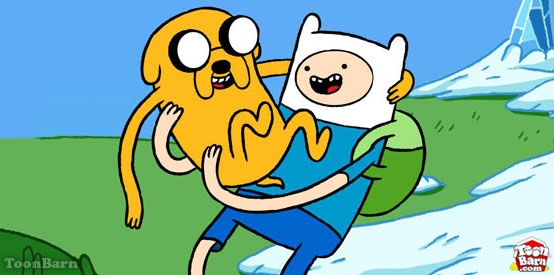
Boy and animal go on adventures:


2. Self-conscious play with genres


3. A large cast of tertiary characters

4. Constant stream of pop culture references and non-sequitors
Shirley: I've seen enough episodes of Friends to know that co-habitation leads to sex, drugs, and something Parade magazine calls "Schwimmer fatigue."
Evil Abed: You're VH1, Robocop 2 and Back to the Future 3. You're the center slice of a square cheese pizza. Actually, that sounds delicious. I'm the center slice of a square cheese pizza. You're Jim Belushi.
Troy: Me and Abed have an agreement. If one of us dies, we stage it to look like a suicide caused by the unjust cancellation of Firefly. We're gonna get that show back on the air buddy!

And what we're all here for:
5. Extreme male bonding
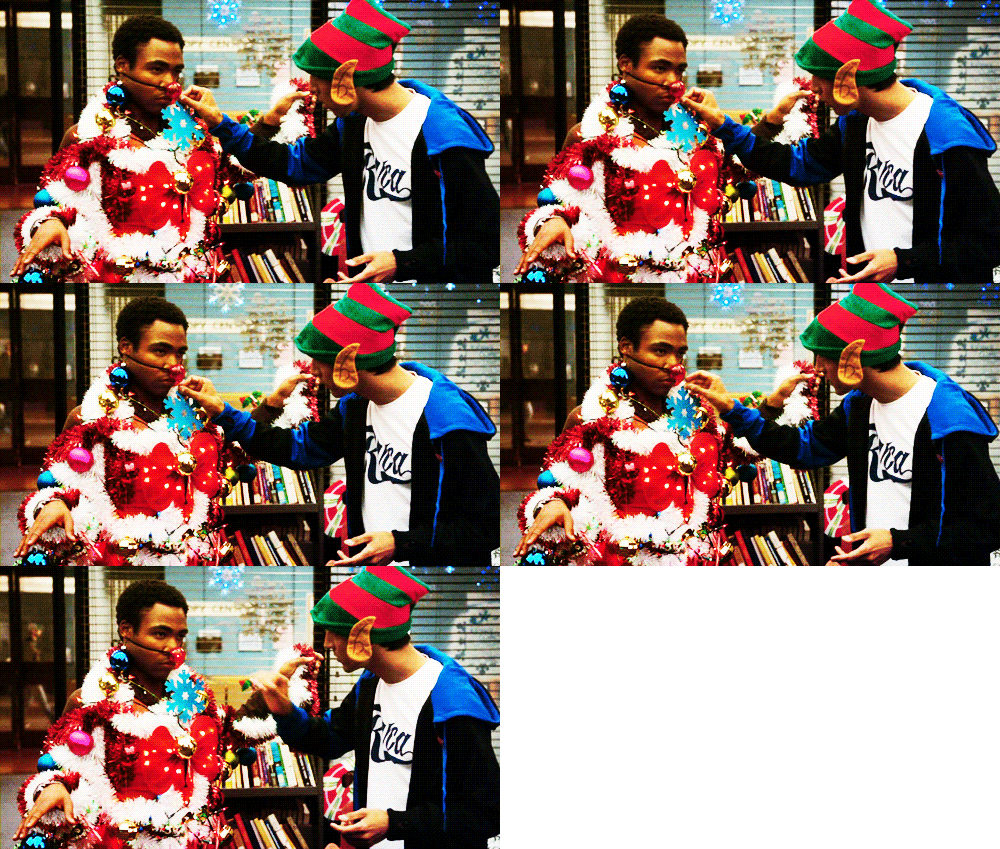


And of course:
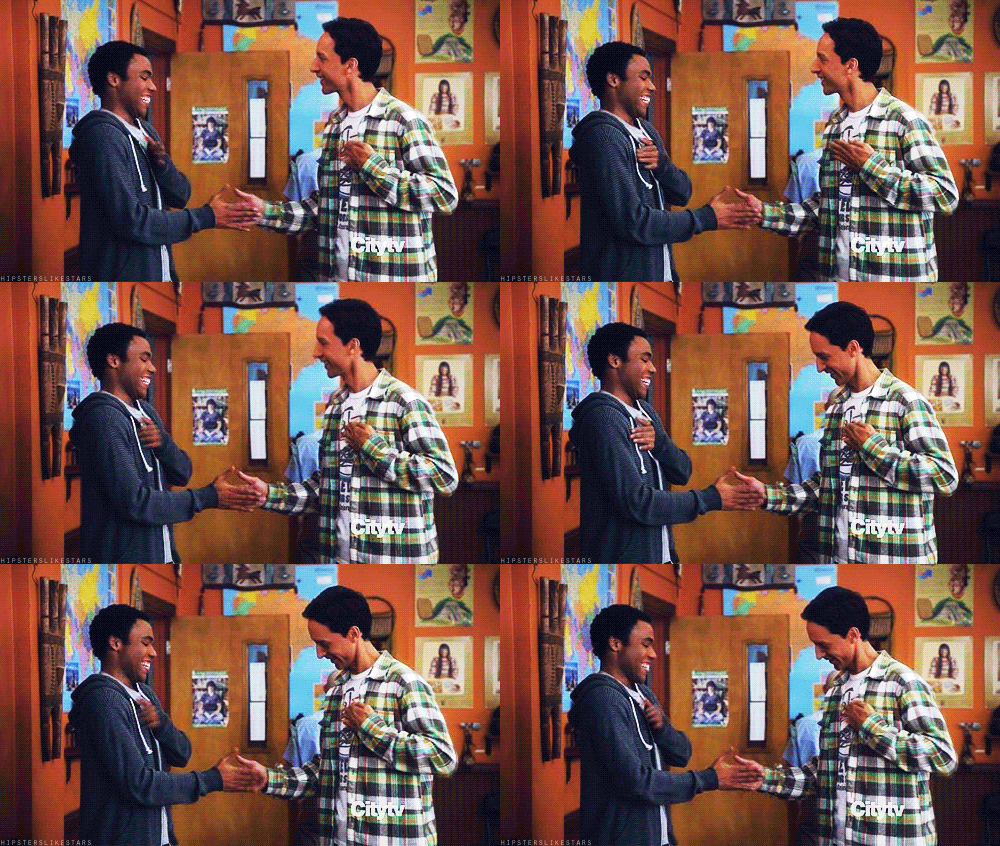
And what have we learned from this? Well, I could have written a few paragraphs on why the shows were similar, and spent have the time for a result twice as professional and half the effort. It is hard to make pictures look effortless and good, even when you aren't using pictures you made yourself.
Later days.
Tuesday, May 15, 2012
Karmic Conniption
Back four or five years ago, there was a little TV show called My Name is Earl. It was a sitcom starring Jason Lee, and it had a simple premise: the lead character, Earl Hickey, was a pretty bad person, and one bad thing after another kept happening to him. After one particular devastation, he vows to do good, specifically by making a list of everything he's ever done bad to someone, and making it up to the person, one by one. The faith behind his actions is karma--for every good deed he does, he claims, something good will happen to him. It was a good (or at least decent) show, but the pseudo-mysticism aspect of it never really worked for me. A morally edifying show is fine at all, and as far as ethical systems or religious institutions go, "do good" is a fairly innocuous manifesto, but the idea that you should do good because you'll be rewarded for it very soon--that bugged me. It seemed to be a sort of sitcom logic, where everything needs to wrap up in 30 minutes, one way or the other, and "they all lived happily ever after because they're nice people" is a good a wrap up as any.
But there's another side to the temptation of such karma. It's not just being rewarded for doing good--it means you've got certainty. Life's full of choices, and it's not always clear if you've made the right one. A system that rewards and punishes quickly is a nice source of feedback. Case in point: I'm in line at the self-checkout. It's a peak time and there's a bit of a wait, and so I spend every minute of it castigating the people in front of me for being so clearly poor with the self-checkout system. I get up there, and, in my desire to show them how it's done, immediately screw up, keying in the wrong number and charging myself an extra 3 dollars. Now, normally, I'd call a cashier over to cancel the item, but I've got a long line behind me yet, and there's only one cashier to manage the four tills, and she's already busy. So, making a split decision, I take the hit. I pay for my groceries, and I amscray. And at the moment, I remember thinking, "This is karma. You deserved to have this happen." Well, yes and no. I felt impatient, I keyed in items in a hurry, I screwed up, and I felt too embarrassed to fix my mistake. That's only karma if karma is another word for cause and effect. If I hadn't felt socially conditioned to refuse to hold up the people behind me any longer, I would have gotten my money back (or rather, never spent it at all). Is that karma? And if the self-checkout system allowed cancellation, I could have avoided the whole thing. Is that karma?
Karma. An attempt to understand the way the world works when forces are beyond our control. A justification for condemning someone for their misdeeds and bad consequences. And a neat mcguffin for a Jason Lee vehicle.
Later Days.
But there's another side to the temptation of such karma. It's not just being rewarded for doing good--it means you've got certainty. Life's full of choices, and it's not always clear if you've made the right one. A system that rewards and punishes quickly is a nice source of feedback. Case in point: I'm in line at the self-checkout. It's a peak time and there's a bit of a wait, and so I spend every minute of it castigating the people in front of me for being so clearly poor with the self-checkout system. I get up there, and, in my desire to show them how it's done, immediately screw up, keying in the wrong number and charging myself an extra 3 dollars. Now, normally, I'd call a cashier over to cancel the item, but I've got a long line behind me yet, and there's only one cashier to manage the four tills, and she's already busy. So, making a split decision, I take the hit. I pay for my groceries, and I amscray. And at the moment, I remember thinking, "This is karma. You deserved to have this happen." Well, yes and no. I felt impatient, I keyed in items in a hurry, I screwed up, and I felt too embarrassed to fix my mistake. That's only karma if karma is another word for cause and effect. If I hadn't felt socially conditioned to refuse to hold up the people behind me any longer, I would have gotten my money back (or rather, never spent it at all). Is that karma? And if the self-checkout system allowed cancellation, I could have avoided the whole thing. Is that karma?
Karma. An attempt to understand the way the world works when forces are beyond our control. A justification for condemning someone for their misdeeds and bad consequences. And a neat mcguffin for a Jason Lee vehicle.
Later Days.
Wednesday, March 28, 2012
It's Always Something in Philadelphia
I'm teaching a pop culture course this term. I've taught the course before, so I decided to shake things up a bit this time, in terms of the artifacts. We've studied Bill Hick's stand-up, 1940s Disney cartoons featuring Nazis, and 1950s government films on what to do in case of a nuclear strike. Today, though, we watched an episode of It's Always Sunny in Philadelphia, and it was the first time I really wondered if I went too far.
It's Always Sunny in Philadelphia is a show whose basic premise is easy to sum up. The core plot is 5 people running a bar: Dennis, the owner who is also a conceited narcissist; Mac, the second-in-command who's played by a guy who ate himself overweight because he thought it would make his character funnier (it did, but wow, that's commitment); Dee, Dennis' sister who is desperately insecure; Charlie, who's on the borderline between kind of dumb and outright insane; and Frank, played by Danny DeVito, who is rich, disgusting, and insane. And from the start, it's been a show that's prized itself in finding humor in disgusting situations. See, for example, Season 4's "Who Pooped the Bed?" or the Season 7 episode where they host a child beauty pageant.
At the same time, though, there's a definite difference from the early and late seasons. I remember watching the first season in two or three sittings, and ending it feeling like I had been made a worse person for watching. And then I stopped feeling that way. I've joked that it was because some part of my moral sense had died, but, going back to the earlier episodes for my class, I think the show itself changed. It started with the introduction of Danny DeVito to the cast, but even his character underwent some changes. He started as a disciplinarian, tough-love father wanting to indulge himself (reminiscent of the father from Titus, actually, another dark comedy) then gradually veered away from that until the Christmas episode a few seasons later where he emerges naked from inside a couch during a party, and unselfconsciously plods his way out of the room.
Don't think that I'm complaining about the new direction, though. It was when the show got "wackier" that I started to really like it. I love the scenes with Charlie's kitten mittens, and his dream journal. I still sing bits from the musical episode. Chardee MacDennis is probably the closest thing on television that I've seen to Calvinball, in terms of absurdist rules. And even though I'm a vegetarian, I am fascinated with the idea of the rum ham. But I have to admit, the show had a lot more edge in the beginning. Look at the topics from the first season: racism, abortion, sex with minors/underage drinking, cancer, gun control, molestation. We are talking about a lot of topics that are taboo for comedy. And the episodes aren't entirely without heart, either; it's pretty clear, for example, in the "Underage Drinking" episode, that the Gang is just dealing with their own issues from high school rather than deliberately wanting to make out with high school kids, and as a 28 year old, I can relate to still carrying around that kind of baggage (just the first part. Not the second. Don't relate to that. At all.).
I don't really have a conclusion here, except the most wishy-washy one ever. I think the show made the right choice by going in a more absurdist direction; the pure dark comedy was pretty depressing, and certainly not sustainable over 8 seasons. At the same time, though, when I was looking for an episode that was interesting in its own right for a class discussion, it was the early stuff I looked at--those are the episodes that really deal with the issues.
Friday, we're watching an episode of Louie, starring the comedian Louie C. K. It's maybe the only example of a show that I can think of that's pulling off the balance between biting, sometimes dark, social commentary and humor.
Later Days
It's Always Sunny in Philadelphia is a show whose basic premise is easy to sum up. The core plot is 5 people running a bar: Dennis, the owner who is also a conceited narcissist; Mac, the second-in-command who's played by a guy who ate himself overweight because he thought it would make his character funnier (it did, but wow, that's commitment); Dee, Dennis' sister who is desperately insecure; Charlie, who's on the borderline between kind of dumb and outright insane; and Frank, played by Danny DeVito, who is rich, disgusting, and insane. And from the start, it's been a show that's prized itself in finding humor in disgusting situations. See, for example, Season 4's "Who Pooped the Bed?" or the Season 7 episode where they host a child beauty pageant.
At the same time, though, there's a definite difference from the early and late seasons. I remember watching the first season in two or three sittings, and ending it feeling like I had been made a worse person for watching. And then I stopped feeling that way. I've joked that it was because some part of my moral sense had died, but, going back to the earlier episodes for my class, I think the show itself changed. It started with the introduction of Danny DeVito to the cast, but even his character underwent some changes. He started as a disciplinarian, tough-love father wanting to indulge himself (reminiscent of the father from Titus, actually, another dark comedy) then gradually veered away from that until the Christmas episode a few seasons later where he emerges naked from inside a couch during a party, and unselfconsciously plods his way out of the room.
Don't think that I'm complaining about the new direction, though. It was when the show got "wackier" that I started to really like it. I love the scenes with Charlie's kitten mittens, and his dream journal. I still sing bits from the musical episode. Chardee MacDennis is probably the closest thing on television that I've seen to Calvinball, in terms of absurdist rules. And even though I'm a vegetarian, I am fascinated with the idea of the rum ham. But I have to admit, the show had a lot more edge in the beginning. Look at the topics from the first season: racism, abortion, sex with minors/underage drinking, cancer, gun control, molestation. We are talking about a lot of topics that are taboo for comedy. And the episodes aren't entirely without heart, either; it's pretty clear, for example, in the "Underage Drinking" episode, that the Gang is just dealing with their own issues from high school rather than deliberately wanting to make out with high school kids, and as a 28 year old, I can relate to still carrying around that kind of baggage (just the first part. Not the second. Don't relate to that. At all.).
I don't really have a conclusion here, except the most wishy-washy one ever. I think the show made the right choice by going in a more absurdist direction; the pure dark comedy was pretty depressing, and certainly not sustainable over 8 seasons. At the same time, though, when I was looking for an episode that was interesting in its own right for a class discussion, it was the early stuff I looked at--those are the episodes that really deal with the issues.
Friday, we're watching an episode of Louie, starring the comedian Louie C. K. It's maybe the only example of a show that I can think of that's pulling off the balance between biting, sometimes dark, social commentary and humor.
Later Days
Friday, March 23, 2012
Friday Quotations: And then all the other ponies laughed at her
"No thanks! I sooo don't read. I'm a world-class athlete. Reading's for eggheads, like you. I am not into reading. It's undeniably, unquestionably, uncool."
--Rainbow Dash, My Little Pony: Friendship is Magic.
My time is spent in questionable pursuits.
Later Days.
--Rainbow Dash, My Little Pony: Friendship is Magic.
My time is spent in questionable pursuits.
Later Days.
Saturday, March 10, 2012
Why You Should Watch Avatar: The Last Airbender
I've recently returned to a second viewing of what may very well be my favorite long-running TV series: Avatar: the Last Airbender. This time round, I've tried to sell my roommates on the show, and results have been... poor. They find the show to simplistic, and too cartoonish. They are wrong. But my attempts to convince them that have gone astray, largely because their exposure to the show extends to whatever episode they happen to stumble in on. Spending five minutes explaining why Aang has hair now or why a turtle duck exists is not going to sell anyone (unless you're a very special sort of anyone). So I thought I'd set out a more detailed, exacting argument here for them, and for anyone else who is still missing out on this show. (I'm breaking it into three posts, 'cause it's really long.)
Wednesday, March 7, 2012
The Last Haiku Bender

I swear I'm going to do a full post on the subject some day, but for now, I would like to remind everyone that Avatar: the Last Air Bender is the only show containing both a haiku rap battle and a giant six-legged flying water buffalo.
That is all.
Later Days.
Friday, March 2, 2012
Friday Quotations: Moar XMas Rap
"If years were seasons, then this December would be the December of our December."
Later Days.
Friday, February 17, 2012
Friday Random Quotations: Guess How My Day's Been Going
[Flashback to Homer's childhood, where a long line of kids and
their various vehicles have all rear-ended and smashed into each
other. Homer and Barney Gumble, as children, are at the front of
the line, wrecked into a tree.]
Barney: Let's never drink again.
[Back to reality. Homer still has the beer in his hand.]
Homer: And we never did. [takes a swig]
--The Simpsons, "Lisa's Sax."
Later Days.
their various vehicles have all rear-ended and smashed into each
other. Homer and Barney Gumble, as children, are at the front of
the line, wrecked into a tree.]
Barney: Let's never drink again.
[Back to reality. Homer still has the beer in his hand.]
Homer: And we never did. [takes a swig]
--The Simpsons, "Lisa's Sax."
Later Days.
Friday, February 10, 2012
Friday Random Quotations: I Could See Tracy Morgan as a castmember of Boondocks
"Guys like us have to pick low-hanging fruit. We look like Far Side characters!" --Frank, 30 Rock.
Later Days.
Later Days.
Subscribe to:
Posts (Atom)