In one of the more questionable uses of my time, I've recently read a hundred issues of the Hulk #201 to #300--that's the period from 1976 to 1984. Most of the period is Bill Mantlo's time as writer on the title, and it's... an odd bag. Join me, then, after the break, for a general discussion of issues 201 to 220, as we talk about such things as deadbeat magicians, over-eager landladies, and the special love between villain and henchman.
Showing posts with label comics. Show all posts
Showing posts with label comics. Show all posts
Wednesday, August 20, 2014

Tuesday, December 10, 2013
Fearless Defenders Covers: More Comics! Because, why not?
This month saw the cancellation of Cullen Bunn and Will Sliney's "Fearless Defenders," proving once again that we can't have nice things. The idea of the series was that Valkyrie was charged by the All-Mother of Asgard (the lady triumvirate that currently rules the place, because let's face it, Odin is pretty terrible at it) to form a new band of Shield Maidens. Valkyrie's reluctance to select contemporary female heroes to do that led to a power vacuum that was filled by other nasty warriors, and she was slowly putting together a team not of shield maidens but of fearless defenders to protect people; as of the cancellation, the ranks included Annabelle Riggs (super genius, unpowered, body merged with Valkyrie's through some weird doings); Misty Knight (bionic private eye), Dani Moonstar (sometimes X-Man); Hippolyta (Marvel's more war-oriented version of Wonder Woman, with the serial numbers field off); Clea (sorceress and frequent paramour of Stephen Strange); Elsa Bloodstone (British, monster hunter, probably best known for her role in Ellis' NextWave); and Ren (Inhuman, whose powers... um... I forget. She's new).
Besides the female-positive cast, the book was... good, usually solid fun, edging towards great, but never quite reaching it, to be honest. I would have preferred a little more character and a little less nonstop action, although I can certainly see how the virtue of the superhero comic is generally that it does it the other way around. But what was great was the covers of the series, drawn by Mark Brooks. Especially towards the end of the run, they were pretty amazing deconstructions of gender and power in various media forms, a perfect purified version of what the series was aspiring to. But I haven't seen anywhere where all of the covers are collected, so I thought I might as well do the honors. In order then, without further ado, I present the covers of Fearless Defenders.






Besides the female-positive cast, the book was... good, usually solid fun, edging towards great, but never quite reaching it, to be honest. I would have preferred a little more character and a little less nonstop action, although I can certainly see how the virtue of the superhero comic is generally that it does it the other way around. But what was great was the covers of the series, drawn by Mark Brooks. Especially towards the end of the run, they were pretty amazing deconstructions of gender and power in various media forms, a perfect purified version of what the series was aspiring to. But I haven't seen anywhere where all of the covers are collected, so I thought I might as well do the honors. In order then, without further ado, I present the covers of Fearless Defenders.
Issue #1

So far, so generic, though it's nice that each hero is facing the other's regular villain type.

Scottie Young drawn variant cover, which is roughly the same action, but everyone is adorable.

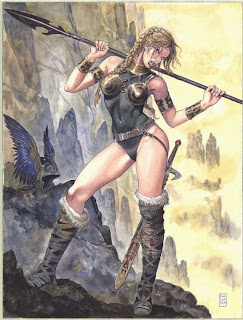
Manara variant, which goes for a pin-up cover-type approach--
A little too much cheesecake, I think.

Deodato variant. ...My, that's a big gun.
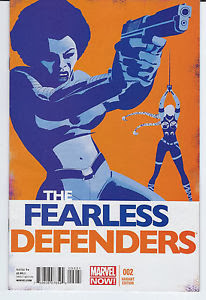
Issue #2

Here's where things start to get interesting. It's a very simple idea for a cover, but it works really well. And it starts a transmedia theme that's going to come up a lot.

Martin's variant cover. I like the way the blue and orange juxtapose.
Issue #3

Back tattoo title. Nice way of establishing Hippolyta's style, and putting her at odds with the existing team.

Jiminez variant. I believe this makes the Wonder Woman analog fairly obvious.
Fearless Defenders #4

This one got a lot of attention when it came out. It has the paper doll play aspect, which is generally a feminized activity, but by virtue of being a comic book cover, and featuring a comic book character, it also says something about how comic book creators and fans "dress up" their (female) characters.
Fearless Defenders AU #4

I'm not sure this one counts, to be honest, as it it's a Jiminez cover and was part of the tie-in to the Age of Ultron series, not this series proper. But I do like the way Wolverine, Hulk, and Captain America look sort of dumbfounded at Hippolyta's beheading.
Fearless Defenders #5

Cover as Street Fighter-esque fighting game, illustrating another way that we play with our superheroes. And illustrating the roster of characters that were felt to fall under the title's mandate, though not all of them ever appeared in its pages proper.

Amanda Conner variant. It's a little more generic (the team pose) but it also shows the variety of Defenders the book could potentially feature.

This, on the other hand, shows no members of the series at all, in order to participate in the "Wolverine Through the Ages" cover series, a bunch of alternative covers that have nothing to do with the comics, but do feature Wolverine from various points in Marvel past, present, and future. Well done, Marvel. You have taken your all-female comic, removed the title characters, and replaced them with your best-selling male character. Very on the nose.
Fearless Defenders #6

Recasting the superhero cover in the genre of the 50s horror comic. Undead Norse vikings lend themselves well to that sort of thing.
Fearless Defenders #7

I think there's a reversal of the manual labor = men stereotype, though we've also got the medium-displacement joke (comic book cover as billboard) and the displacement of labor (superheroes in costumes wearing uniforms for manual labor).
Fearless Defenders #8

Cover as sketchpad, and one that's definitely emphasizing the female form. The pencils are eraser are a nice touch.
Fearless Defenders #9

Another example of re-appropriating a genre that's highly charged when it comes to female depictions: manga. The bottom has Dani Moonstar saying "Okay, now we're just pandering," in part to show the reader, yes, we realize what we're doing here.
Fearless Defenders 10

Another media appropriation, this time the hip-hop album cover. Makes a nice introduction to the new character too.
Fearless Defenders 11
 Soviet-esque poster. Kind of surprised that they didn't put Natasha in the front here, although any chance that avoids stereotyping a character who is already "Russian spy" is probably a good idea.
Fearless Defenders 12
 And here we have the end of the line, as the train pulls into the cancellation station. This is probably best of the bunch: a pastiche of the romance novel covers, and maybe the only one that can credibly claim to be inverting heteronormative tropes as well as gender tropes. I also like that it's Riggs that's holding Valkyrie, as it demonstrates how their roles in relation to each other have changed over the course of the series.
Fearless Defenders 10

Another media appropriation, this time the hip-hop album cover. Makes a nice introduction to the new character too.
Fearless Defenders 11

Fearless Defenders 12

So... what have we learned? Well, variant covers aren't all they're cracked up to be; with all due respect to the artists' skills, most of them fail to hit the same height as the original. And that's no surprise; you've got a regular person who's connected to the entire series, compared to someone who's just in to do a single issue, then the regular artist should be able to connect better to the series' theme; otherwise, they probably shouldn't be the regular artist. Moreover, we've got a pretty powerful case that the comic book cover can and should be used better than it is. The covers here generally don't connect to the events of the book, but they do illustrate the characters we should be paying attention to, and do a great job of presenting visually the themes that the book wants to claim as its own. That's so much more than a generic pose or random action shot that the typical cover conveys. And it really explores what the cover is allowed to do, as a type and medium. I don't think I've ever become a fan of an artist before just for their cover designs, but I will look out for whatever Mark Brooks does next.
Tuesday, December 3, 2013
Super Heroin'
Words aplenty about Joe Casey's run on Adventures of Superman (or rather, the run from issue #600 to #623) after the break.
Wednesday, August 14, 2013
This Week in Panels: Comics Outside the Big Two
It's time for everyone's favorite not-even-remotely-weekly feature, This Week in Panels! Now featuring panels from Archer and Armstrong #12, Saga #13, and Astro City #3. All after the break.

Sunday, July 7, 2013
Bibliophilia: Gothic Animals at University of King's College
“There are two motives for reading a book; one, that you enjoy it; the other, that you can boast about it.”
― Bertrand Russell
The University of Waterloo seems to have retreated back into hiatus, so the Canadian Grand Tour continues, with the University of King's College in Halifax. The library is part of a group of Nova Scotia libraries, but as far as I can tell, that collection is distinct from Acadia's, Cape Breton's, and Dalhousie's, so I guess we haven't looked at it before. There's no new books page, so I'll limit the location to King's College, set it to books published in 2013, and see what comes up, after the break. As always, a bold H indicates that the book is in the UW holdings.
― Bertrand Russell
The University of Waterloo seems to have retreated back into hiatus, so the Canadian Grand Tour continues, with the University of King's College in Halifax. The library is part of a group of Nova Scotia libraries, but as far as I can tell, that collection is distinct from Acadia's, Cape Breton's, and Dalhousie's, so I guess we haven't looked at it before. There's no new books page, so I'll limit the location to King's College, set it to books published in 2013, and see what comes up, after the break. As always, a bold H indicates that the book is in the UW holdings.
Saturday, April 13, 2013
Bibliophile: Adventures in Literature at the University of Winnipeg, now with more Spaceballs
“Books are the quietest and most constant of friends; they are the most
accessible and wisest of counselors, and the most patient of teachers.”
― Charles William Eliot
This is Bibliophile.
This week, we'll be commenting on the new books from the library of the University of Winnipeg, after the break..
― Charles William Eliot
This is Bibliophile.
This week, we'll be commenting on the new books from the library of the University of Winnipeg, after the break..
Friday, April 12, 2013
Friday Quotations: DOOOOOM

Later Days.
Sunday, February 10, 2013
Bibliophile: He Shoots, He Glowers! : The classic NHL gothic romance that never was, and some books that actually exist from University of BC
“Never trust anyone who has not brought a book with them.”
― Lemony Snicket, Horseradish: Bitter Truths You Can't Avoid
This is Bibliophile.
We're returning to University of British Columbia this week, the largest university in BC (apparently, population-wise; I would have assumed the biggest was Simon Fraser, so there you go).
― Lemony Snicket, Horseradish: Bitter Truths You Can't Avoid
This is Bibliophile.
We're returning to University of British Columbia this week, the largest university in BC (apparently, population-wise; I would have assumed the biggest was Simon Fraser, so there you go).
Saturday, December 29, 2012
Book Triad: Superheroes, Cthulu, and some fiction
Guess what! We're still doing the Book Triad segment! This time, we'll be looking at
Weird Realism: Lovecraft and Philosophy by Graham Harman
Angelmaker by Nick Harkaway
Superheroes!: Capes and Crusaders in Comics and Films by Roz Kaveney
Reviews after the break.
Weird Realism: Lovecraft and Philosophy by Graham Harman
Angelmaker by Nick Harkaway
Superheroes!: Capes and Crusaders in Comics and Films by Roz Kaveney
Reviews after the break.
Friday, December 28, 2012
Friday Random Quotations: Don't Get Me Started on Nate Grey
"The Marvel Universe, by contrast, has always glorified in the proliferation of timelines to an extent that it sometimes becomes almost impossible to keep straight in one's mind, yet somehow it remains accessible to most examples: Rachel Grey is the daughter of Scott Summers and Jean Grey but was born into a timeline, came to the present from a dystopian future that never happened. Cable, her half-brother, Summers' son by Madeleine, the woman he married when Jean was supposedly dead, was sent into the future to have a disease cured and came back when he was significantly older than his father."--Roz Kaveney, Superheroes! Capes and Crusaders in Comics and Films.
I'm still waiting for the story where it turns out that Cable is his own grandpa. Granted, it would mean displacing Corsair, but I think we'd all be okay with that. Anyway, Kaveney's book is very good; it balances accessibility with depth to make a real study of what makes superhero comics worth investigating.
I'm still waiting for the story where it turns out that Cable is his own grandpa. Granted, it would mean displacing Corsair, but I think we'd all be okay with that. Anyway, Kaveney's book is very good; it balances accessibility with depth to make a real study of what makes superhero comics worth investigating.
Sunday, November 25, 2012
Bibliophile: Art at Emily Carr, in the Funkhouser Fashion
“A room without books is like a body without a soul.”
― Marcus Tullius Cicero
This is Bibliophile.
― Marcus Tullius Cicero
This is Bibliophile.
Monday, November 12, 2012
Bibliophile: Lethbridge--Oxbridge's less fictional cousin
In Soviet Russia, the books read you.
That is an outdated joke.
This is Bibliophile.
That is an outdated joke.
This is Bibliophile.
Sunday, October 7, 2012
Bibliophile: The Wizard of Oz & Affirmative Action: Where are the Tin Woodswomen?
My feet were cold last night, so I didn't get any sleep. Something smoetinhg shmneoitg nonsequitor.
This is Bibliophile.
This is Bibliophile.
Wednesday, September 26, 2012
Of course, now the phrase "human centipede" has a different meaning.
Every now and then, I think everyone should take a moment to remember that Lana Lang, Superman's crush from Smallville, deliberately turned herself on a regular basis into a human/bug hybrid monstrosity.
And that's why Lois always won.
Later Days.
 | ||||
| LEST WE FORGET |
Later Days.
Friday, September 21, 2012
Friday Quotations: Blinkin' Amazing

The catch when I was originally reading them was that the library I was borrowing them from had the first volumes of the original series, and the first volumes of the reboot, but missed rather large swathes in between. So I was rather confused. Having now read the whole series, I'll admit it all hangs together--even the reboot can be worked into actual continuity, if you squint a bit. The real problem is that the series' tone and purpose shifts wildly with new writers. Neil Gaiman created the series, and it was a fairly simple premise: an ordinary British boy is put on a whirlwind tour of the magic side of reality, led by the high profile "good" magic characters of the DC universe. He has the potential to be more powerful, magic-wise, than any of them, and they ask if he wanted this power. I won't go so far to say that Timothy Hunter was a MacGuffin for Gaiman to do a DC magical tour, but he is, I think, supposed to be deliberately vague personality-wise, aside from general "wise-ass Brit kid" in order to present him as an Everyman type figure. (Like Harry Potter, but about a decade earlier.)
You can't really hang an ongoing on that premise, though, so the first writer of the main series, John Ney Reiber, developed a supporting cast. Tim had a pretty miserable life at that point; sure, he had magical powers, but people were always trying to kill him for them, and his father was a one-armed drunk, still feeling guilty about the car crash that took his arm and his wife's life. Tim's gloom is counterbalanced by Molly, his next door neighbor, a spunky little Irish girl. Much of Reiber's run can be classified as a teenage love story, and Molly is portrayed as such a vital character that I was okay with that. My big problem with the following writers is that they went a little overboard in the overwrought, emo-side of Tim, and they never got Molly quite right; she went from being her own unique character to being Tim's Supporting Cast, role: Girlfriend.
Okay, I felt I needed to rant about that. Still, the scene above? Good scene.
Later Days.
Sunday, September 2, 2012
Bibliophile: Priest's Whores, Killer Poems, and Electronic Mind Machines
If you think about it, this blog feature is pretty much the Kim Kardashian of library book searching.
This is Bibliophile.
Friday, July 13, 2012
Friday Quotations: Gestating Slave-Wombs
"I came to this world 22 seasons ago in a breedmart warehouse in Chandalar's fleshmarket district. My father was an automated seed sprinkler. My mother, one of the thousands of frozen eggs harvested each month from female factory workers as part of their government-mandated body-taxes. I gestated in a slave-womb, in the belly of an alien brought in chains from some conquered world or another, an alien whose body was not designed for birthing Shi'ar babies. So when I was born, it was in a rush of blood and alien death screams. By the time I drew my first breath, I'd already claimed my first kill for the Imperium." --Warbird, from Wolverine and the X-Men 13.
Oh comics. Never change.
Later Days.
Oh comics. Never change.
Later Days.
Thursday, April 19, 2012
Recommendations: Web Comics
I read a lot of webcomics. And that's an understatement. At the moment, I regularly check out xkcd, the Gun Show, Saturday Morning Breakfast Cereal, Hark a Vagrant, Penny Arcade, Scenes From a Multiverse, Guilded Age, Looking for Group, Girls With Slingshots, Questionable Content, Something Positive, Order of the Stick,Goblins, Starslip, Oglaf, Wondermark, Wonderella, and Girl Genius. And I'm almost certainly forgetting some of them. I thought that, for today's recommendation, I'd randomly blather on about three of them, chosen by a random number generator. I'll discuss them, after break.
Monday, April 16, 2012
Recommendations: American Vampire
I thought I'd try a full week of daily blogging, to make up for the relative lack of posts in recent weeks. And of course, as soon as I sit down, absolutely nothing worth writing about comes to mind. So we'll try this: a week of me recommending various things, from various media. Frankly, though, I suspect some will be less me recommending things and more me conducting a run-by analyzing. Still, as the boy with the TNT plunger said, this might be fun. Today's recommendation: the comic book series American Vampire, by Scott Snyder and Rafael Albuquerque.
It hasn't been so long since my last graphic novel recommendation, to be honest. But DMZ is a very different from American Vampire. DMZ, from its beginning, had a message and a direction to it. American Vampire is more rambling, more adventure-driven--though I suspect it has more depth to it than might be suggested at first glance. To understand American Vampire, you need to pay attention to both words in its title, the American as much as the Vampire. I've said previously that magic in fantasy literature is always a metaphor--the same holds true for supernatural creatures in general, and the vampire in particular. In fact, the vampire has been one of the more heavily hit beings in recent popular culture memory, thanks to Vampire Diaries, True Blood, and, of course, Twilight. But at the same time, the core associations of what a vampire means haven't really changed that much since Bram Stocker's Dracula: it's about blood, life-force, forbidden desires, and unnatural perversions. Twilight directed the desires onto high school romance, True Blood mapped the perversions onto sexuality directly ("God Hates Fangs" as it says in the opening sequence), and Vampire Diaries... well, I've actually never seen Vampire Diaries. Anyone want to fill me in, there? The point is, American Vampire does something a little different. To the usual list of vampire symbolism, it adds one more: vampire as a metaphor for American history.
Plotwise, this happens fairly simply. The power and genus of a vampire, in this story's fictional universe, depend on the region of the victim is from. Japanese vampires depict a power set that's different from the Haitian vampire that's different from the European vampire. And the story begins with the creation of Skinner Sweet, a Western outlaw that finds out he's got all the strength and speed of vampire without that pesky sunlight problem. The first story arc alternates between Sweet in the Wild West, when he was originally turned (and it should be noted for horror fans that these portions were written by Stephen King), and the 20th century dawn of Hollywood, when he recruits his first accomplice. Note that both of these time periods feature events that quintessentially American, that couldn't have occurred anywhere else but America. Other arcs follow this pattern, taking place in the construction of the Hoover Dam in Nevada, and the German and Japanese fronts in WWII. Sweets and his vampiric descendents are there to witness it all, and by their very presence, they construct an alternate view of American history, one based on vice and violence and bloodshed.
The metaphor is never the forefront of the plot; rather, it's the setting that adds local color, or at most drives the characters' motivations. But it gives American Vampire another level of depth beyond the surface adventure stories, something that makes it stand up as more than either just another vampire story, or just another action comic book. It's bloody, it's unflinching, and it's worth a look.
Later Days.
It hasn't been so long since my last graphic novel recommendation, to be honest. But DMZ is a very different from American Vampire. DMZ, from its beginning, had a message and a direction to it. American Vampire is more rambling, more adventure-driven--though I suspect it has more depth to it than might be suggested at first glance. To understand American Vampire, you need to pay attention to both words in its title, the American as much as the Vampire. I've said previously that magic in fantasy literature is always a metaphor--the same holds true for supernatural creatures in general, and the vampire in particular. In fact, the vampire has been one of the more heavily hit beings in recent popular culture memory, thanks to Vampire Diaries, True Blood, and, of course, Twilight. But at the same time, the core associations of what a vampire means haven't really changed that much since Bram Stocker's Dracula: it's about blood, life-force, forbidden desires, and unnatural perversions. Twilight directed the desires onto high school romance, True Blood mapped the perversions onto sexuality directly ("God Hates Fangs" as it says in the opening sequence), and Vampire Diaries... well, I've actually never seen Vampire Diaries. Anyone want to fill me in, there? The point is, American Vampire does something a little different. To the usual list of vampire symbolism, it adds one more: vampire as a metaphor for American history.
Plotwise, this happens fairly simply. The power and genus of a vampire, in this story's fictional universe, depend on the region of the victim is from. Japanese vampires depict a power set that's different from the Haitian vampire that's different from the European vampire. And the story begins with the creation of Skinner Sweet, a Western outlaw that finds out he's got all the strength and speed of vampire without that pesky sunlight problem. The first story arc alternates between Sweet in the Wild West, when he was originally turned (and it should be noted for horror fans that these portions were written by Stephen King), and the 20th century dawn of Hollywood, when he recruits his first accomplice. Note that both of these time periods feature events that quintessentially American, that couldn't have occurred anywhere else but America. Other arcs follow this pattern, taking place in the construction of the Hoover Dam in Nevada, and the German and Japanese fronts in WWII. Sweets and his vampiric descendents are there to witness it all, and by their very presence, they construct an alternate view of American history, one based on vice and violence and bloodshed.
The metaphor is never the forefront of the plot; rather, it's the setting that adds local color, or at most drives the characters' motivations. But it gives American Vampire another level of depth beyond the surface adventure stories, something that makes it stand up as more than either just another vampire story, or just another action comic book. It's bloody, it's unflinching, and it's worth a look.
Later Days.
Friday, March 30, 2012
Friday Quotations: It's Funny Because They're Not From Around Here
Volstagg. I noticed you and the serving wench were getting along verrrrrrrry nicely, Fandral.
Fandral. Oh, Becky? Yes, a charming girl. I suspect she may be a witch.
Volstagg. A witch?
Fandral. She attempted to place a curse upon me by making strange marks on a piece of paper and slipping it into my pocket. Fortunately, I spotted the ruse and burned it in time.
The key to the comedy here is to imagine the immensely fat Volstagg leering hugely as he draws out "verrrrry." Taken from Thor: The Mighty Avenger vol 1, in which the Asgardian god Thor meets up with a bunch of his buddies to go to a pub night in Britain. It also contains the best mockery of secret identities I've seen in a while: "Do you think you should check on him? He has been in the loo a long time, no?" "Mmm? No, it's okay. He's Captain Britain. He thinks his friends don't know, but he's terrible at keeping it a secret. So we pretend we don't notice. Another one?"
Thor: The Mighty Avenger was written by Roger Langridge (who also did phenomenal work on the comic book version of the Muppets) and drawn by Chris Samnee. The series was cancelled after eight issues, because people like you and me don't appreciate nice things while they're here. Well, we'll always have Dunkirk.
Later Days.
Fandral. Oh, Becky? Yes, a charming girl. I suspect she may be a witch.
Volstagg. A witch?
Fandral. She attempted to place a curse upon me by making strange marks on a piece of paper and slipping it into my pocket. Fortunately, I spotted the ruse and burned it in time.
The key to the comedy here is to imagine the immensely fat Volstagg leering hugely as he draws out "verrrrry." Taken from Thor: The Mighty Avenger vol 1, in which the Asgardian god Thor meets up with a bunch of his buddies to go to a pub night in Britain. It also contains the best mockery of secret identities I've seen in a while: "Do you think you should check on him? He has been in the loo a long time, no?" "Mmm? No, it's okay. He's Captain Britain. He thinks his friends don't know, but he's terrible at keeping it a secret. So we pretend we don't notice. Another one?"
Thor: The Mighty Avenger was written by Roger Langridge (who also did phenomenal work on the comic book version of the Muppets) and drawn by Chris Samnee. The series was cancelled after eight issues, because people like you and me don't appreciate nice things while they're here. Well, we'll always have Dunkirk.
Later Days.
Subscribe to:
Posts (Atom)