Your mother rests in a vast cave of marzipan, the walls decorated with
thousands of glimmering boiled sweets, forming elaborate patterns and
detailing a tableau of her life as a gracious and wise Queen. She
herself is huge, her hot pink body resting atop a clutch of jellybean eggs.
"My dear daughter, please come in. It is time we spoke about your future."
--Candy Ant Princess
I rule my candy ant minions with an iron fist. Wait, ants don't have fists, do they? Check out the Twine game here.
Later Days.
Showing posts with label interactive fiction. Show all posts
Showing posts with label interactive fiction. Show all posts
Friday, May 10, 2013

Tuesday, August 14, 2012
Work in Progress: Montfort's All Alike
Continuing one of our irregular features, here's another edition of Work in Progress, in which I copy and paste notes I've made on a book (in this case, Nick Montfort's Twisty Little Passages), so you get the argument without any organization, mechanical improvement, or context.
You're welcome.
Incidentally, I've written on interactive fiction before, and in a more personal context. Take a look if you missed it the first time around, because I think it may be one of my better posts.
You're welcome.
Incidentally, I've written on interactive fiction before, and in a more personal context. Take a look if you missed it the first time around, because I think it may be one of my better posts.
Wednesday, July 20, 2011
Public Service Announcement
I know we have a lot of the same readers, (and that publicity-wise, he's already cast his net to some fish that are a lot bigger than yours truly) but I would like to mention that a friend of mine is on Day 2 of a 4-week event, the Bureau. It's a multimedia murder mystery. It's an online mass narrative. It's even, dare I say, a game. And he's designed it to be accessible at any point, so take a look when you can. Further attempts at description on my part aren't really going to do it justice, so I recommend that you check it out for yourself; it's good stuff.
Later Days.
Later Days.
Friday, March 4, 2011
IF another road was taken
Today's reading has been "Gaming, Identity, and Literacy," an essay by Daniel Keller et al., an essay from the anthology Gaming Lives in the Twenty-First Century: Literate Connections. The essay essentially argues that those were heavy child readers in the 80s and had access to computers were drawn towards Interactive Fiction (essentially, text-based games like Zork and Hitchhiker's Guide that functioned through use of a parser) which in turn drew them towards computer programming. Their point is that computer games, and Interactive Fiction in particular, can be and have been historically significant in encouraging children to develop computer skills outside a classroom setting. Their approach is vaguely ethnographic (or to be more accurate, their approach is I, in my vague understanding of ethnography, vaguely understand to be ethnographic): they interview five people who went through the childhood reader --> IF fiction player--> career in computers. After the article, I had two divergent thoughts:
1) On ethnography (or maybe anthropology) in general: I've noticed that, in the field, there's a temptation to let cultural development and individual, childhood development to stand in as substitutes for each other. In other words, there's an implicit argument that the way a past culture is more primitive than a modern equivalent is similar to the way a child is more primitive than an adult. As an enlightened English student (with a whole different set of disciplinary-based prejudices and blind spots), this tendency bothers me. First, on a purely postcolonial level, it's insulting to any culture it's applied to, because it translates into the "Father knows best" Western Imperialist model. And second, it tends to lend itself to the primitive/modern binaries employed by thinkers from J. J. Rousseau to Jean Baudrillard. And if there's one thing English teaches over and over again, it's that binaries are no good. You're either in favor of them or not, there's no middle ground.
2) I can't help but wonder how Keller and Co.'s theory applies to me personally. I certainly qualified as well-read. Granted, most of my childhood education took place in the 90s, not the 80s, but given the technological access available in rural Saskatchewan, a lot of the same restrictions--particularly in terms of access to computer games--applies. I remember growing up not on IF games, particularly, but on graphic adventure games that used a parser and the Apple II to operate: Transylvania, The Wizard of Oz, Oregon Trail (even less of an IF, but you get the idea). And I took the computer programming classes offered, meager though they were (which was a fault of the curriculum, not the teacher; he was incredibly encouraging). The big difference, I think, is that my home computer wasn't a PC but a Mac. The game --> programming connection worked... differently... for Macs. First, there was the problem that Mac games were notably fewer, which, conversely, meant they were better known among players, because everyone played the same thing. It's an interesting fact, for example, that nearly every scholar who works on gaming and had a Mac in the 90s will eventually write something about Beyond Dark Castle.
It looked like this:
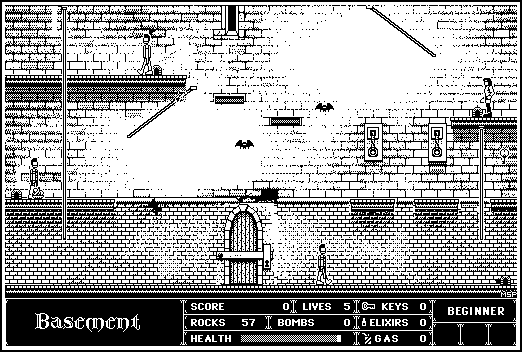
(I recommend looking it up on Youtube, if you're interested, because the real selling point of the game is the grunting sound the hero made every time he got hit. And if you were playing like I was, he got hit a lot.)
But there were still enough games to spark an interest; in fact, I remember attempting to cobble together my own IF game based on the Macintosh HyperCard program.
A bigger reason, I suspect, that I stayed a lit nerd instead of graduating to computer geek is the one Sherry Turkle mentions in her book, Life on the Screen.. She argues that the PC of the era carried with it a sense of modernism, in that it championed itself as the machine you could take apart and build, with programs that allowed and enabled homebrew experimental programming. The Mac, on the other hand, with its newly-coined desktop and hidden files, was postmodern, and geared towards keeping the operating aspects invisible. I could play with a program like HyperCard, which allowed basic linking and parsing, but any deeper level of programming was kept hidden away. Would things have turned out differently if my parents had brought home a PC? Would my life be markedly different if I was busy modding Wolfenstein instead of reading Douglas Adams? Would I have traded in my library card for a floppy disk?
Well, no, probably not. Again, rural Saskatchewan did not lend itself to computer prodigies. And frankly, I really liked the reading part. I think I'm pretty happy with the way things turned out on that front--and it's not like I haven't come back to the games in the end.
Still, one wonders what might have happened. There but the grace of an algorithm go I...
Later Days.
1) On ethnography (or maybe anthropology) in general: I've noticed that, in the field, there's a temptation to let cultural development and individual, childhood development to stand in as substitutes for each other. In other words, there's an implicit argument that the way a past culture is more primitive than a modern equivalent is similar to the way a child is more primitive than an adult. As an enlightened English student (with a whole different set of disciplinary-based prejudices and blind spots), this tendency bothers me. First, on a purely postcolonial level, it's insulting to any culture it's applied to, because it translates into the "Father knows best" Western Imperialist model. And second, it tends to lend itself to the primitive/modern binaries employed by thinkers from J. J. Rousseau to Jean Baudrillard. And if there's one thing English teaches over and over again, it's that binaries are no good. You're either in favor of them or not, there's no middle ground.
2) I can't help but wonder how Keller and Co.'s theory applies to me personally. I certainly qualified as well-read. Granted, most of my childhood education took place in the 90s, not the 80s, but given the technological access available in rural Saskatchewan, a lot of the same restrictions--particularly in terms of access to computer games--applies. I remember growing up not on IF games, particularly, but on graphic adventure games that used a parser and the Apple II to operate: Transylvania, The Wizard of Oz, Oregon Trail (even less of an IF, but you get the idea). And I took the computer programming classes offered, meager though they were (which was a fault of the curriculum, not the teacher; he was incredibly encouraging). The big difference, I think, is that my home computer wasn't a PC but a Mac. The game --> programming connection worked... differently... for Macs. First, there was the problem that Mac games were notably fewer, which, conversely, meant they were better known among players, because everyone played the same thing. It's an interesting fact, for example, that nearly every scholar who works on gaming and had a Mac in the 90s will eventually write something about Beyond Dark Castle.
It looked like this:
(I recommend looking it up on Youtube, if you're interested, because the real selling point of the game is the grunting sound the hero made every time he got hit. And if you were playing like I was, he got hit a lot.)
But there were still enough games to spark an interest; in fact, I remember attempting to cobble together my own IF game based on the Macintosh HyperCard program.
A bigger reason, I suspect, that I stayed a lit nerd instead of graduating to computer geek is the one Sherry Turkle mentions in her book, Life on the Screen.. She argues that the PC of the era carried with it a sense of modernism, in that it championed itself as the machine you could take apart and build, with programs that allowed and enabled homebrew experimental programming. The Mac, on the other hand, with its newly-coined desktop and hidden files, was postmodern, and geared towards keeping the operating aspects invisible. I could play with a program like HyperCard, which allowed basic linking and parsing, but any deeper level of programming was kept hidden away. Would things have turned out differently if my parents had brought home a PC? Would my life be markedly different if I was busy modding Wolfenstein instead of reading Douglas Adams? Would I have traded in my library card for a floppy disk?
Well, no, probably not. Again, rural Saskatchewan did not lend itself to computer prodigies. And frankly, I really liked the reading part. I think I'm pretty happy with the way things turned out on that front--and it's not like I haven't come back to the games in the end.
Still, one wonders what might have happened. There but the grace of an algorithm go I...
Later Days.
Subscribe to:
Posts (Atom)