"Books are for mooks." --Timon the Meerkat
This is Bibliophile.
It's been a long time since I've done Bibliophile, a look at the new books available at a randomly chosen Canadian university library. In part, that's because the blogging bug in general no longer creates the itch in me it once did (note to self: come up with better metaphor), but also because, even in the compromised, 12 books per post version, it was still regularly taking over 3 hours to compose. So we'll play around with the format a bit, and see if we can't come up with something still useful, but less time-consuming. After the break, then, six new books from the University of Calgary. As always, a bolded H marks a book also held by the University of Waterloo.
(In other news, my computer reset on me, meaning I lost all unsaved work. Normally that wouldn't be a problem, but I actually was working at the time for once, and lost five pages of the dissertation. Yes, I should have saved more frequently. I am aware of this fact. Believe me, I am aware of this fact. The level of my awareness could not currently be overstated. If the sounds of my curses could have been harnessed, the winter heating bill would be a thing of the past.)
Sunday, December 15, 2013

Wednesday, December 11, 2013
80 Hours, and I'm still stuck at the Snakemen's place
I did a podcast with a few of my fellow game scholars on the videogame Dark Souls. We put it up on at that site I work, First Person Scholar. You can listen to it here.
Later Days.
Later Days.
Tuesday, December 10, 2013
Fearless Defenders Covers: More Comics! Because, why not?
This month saw the cancellation of Cullen Bunn and Will Sliney's "Fearless Defenders," proving once again that we can't have nice things. The idea of the series was that Valkyrie was charged by the All-Mother of Asgard (the lady triumvirate that currently rules the place, because let's face it, Odin is pretty terrible at it) to form a new band of Shield Maidens. Valkyrie's reluctance to select contemporary female heroes to do that led to a power vacuum that was filled by other nasty warriors, and she was slowly putting together a team not of shield maidens but of fearless defenders to protect people; as of the cancellation, the ranks included Annabelle Riggs (super genius, unpowered, body merged with Valkyrie's through some weird doings); Misty Knight (bionic private eye), Dani Moonstar (sometimes X-Man); Hippolyta (Marvel's more war-oriented version of Wonder Woman, with the serial numbers field off); Clea (sorceress and frequent paramour of Stephen Strange); Elsa Bloodstone (British, monster hunter, probably best known for her role in Ellis' NextWave); and Ren (Inhuman, whose powers... um... I forget. She's new).
Besides the female-positive cast, the book was... good, usually solid fun, edging towards great, but never quite reaching it, to be honest. I would have preferred a little more character and a little less nonstop action, although I can certainly see how the virtue of the superhero comic is generally that it does it the other way around. But what was great was the covers of the series, drawn by Mark Brooks. Especially towards the end of the run, they were pretty amazing deconstructions of gender and power in various media forms, a perfect purified version of what the series was aspiring to. But I haven't seen anywhere where all of the covers are collected, so I thought I might as well do the honors. In order then, without further ado, I present the covers of Fearless Defenders.






Besides the female-positive cast, the book was... good, usually solid fun, edging towards great, but never quite reaching it, to be honest. I would have preferred a little more character and a little less nonstop action, although I can certainly see how the virtue of the superhero comic is generally that it does it the other way around. But what was great was the covers of the series, drawn by Mark Brooks. Especially towards the end of the run, they were pretty amazing deconstructions of gender and power in various media forms, a perfect purified version of what the series was aspiring to. But I haven't seen anywhere where all of the covers are collected, so I thought I might as well do the honors. In order then, without further ado, I present the covers of Fearless Defenders.
Issue #1

So far, so generic, though it's nice that each hero is facing the other's regular villain type.

Scottie Young drawn variant cover, which is roughly the same action, but everyone is adorable.

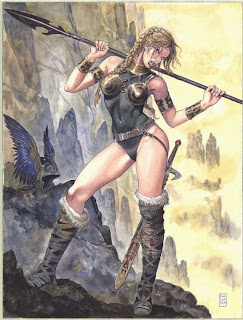
Manara variant, which goes for a pin-up cover-type approach--
A little too much cheesecake, I think.

Deodato variant. ...My, that's a big gun.
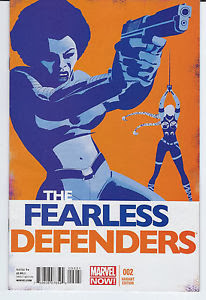
Issue #2

Here's where things start to get interesting. It's a very simple idea for a cover, but it works really well. And it starts a transmedia theme that's going to come up a lot.

Martin's variant cover. I like the way the blue and orange juxtapose.
Issue #3

Back tattoo title. Nice way of establishing Hippolyta's style, and putting her at odds with the existing team.

Jiminez variant. I believe this makes the Wonder Woman analog fairly obvious.
Fearless Defenders #4

This one got a lot of attention when it came out. It has the paper doll play aspect, which is generally a feminized activity, but by virtue of being a comic book cover, and featuring a comic book character, it also says something about how comic book creators and fans "dress up" their (female) characters.
Fearless Defenders AU #4

I'm not sure this one counts, to be honest, as it it's a Jiminez cover and was part of the tie-in to the Age of Ultron series, not this series proper. But I do like the way Wolverine, Hulk, and Captain America look sort of dumbfounded at Hippolyta's beheading.
Fearless Defenders #5

Cover as Street Fighter-esque fighting game, illustrating another way that we play with our superheroes. And illustrating the roster of characters that were felt to fall under the title's mandate, though not all of them ever appeared in its pages proper.

Amanda Conner variant. It's a little more generic (the team pose) but it also shows the variety of Defenders the book could potentially feature.

This, on the other hand, shows no members of the series at all, in order to participate in the "Wolverine Through the Ages" cover series, a bunch of alternative covers that have nothing to do with the comics, but do feature Wolverine from various points in Marvel past, present, and future. Well done, Marvel. You have taken your all-female comic, removed the title characters, and replaced them with your best-selling male character. Very on the nose.
Fearless Defenders #6

Recasting the superhero cover in the genre of the 50s horror comic. Undead Norse vikings lend themselves well to that sort of thing.
Fearless Defenders #7

I think there's a reversal of the manual labor = men stereotype, though we've also got the medium-displacement joke (comic book cover as billboard) and the displacement of labor (superheroes in costumes wearing uniforms for manual labor).
Fearless Defenders #8

Cover as sketchpad, and one that's definitely emphasizing the female form. The pencils are eraser are a nice touch.
Fearless Defenders #9

Another example of re-appropriating a genre that's highly charged when it comes to female depictions: manga. The bottom has Dani Moonstar saying "Okay, now we're just pandering," in part to show the reader, yes, we realize what we're doing here.
Fearless Defenders 10

Another media appropriation, this time the hip-hop album cover. Makes a nice introduction to the new character too.
Fearless Defenders 11
 Soviet-esque poster. Kind of surprised that they didn't put Natasha in the front here, although any chance that avoids stereotyping a character who is already "Russian spy" is probably a good idea.
Fearless Defenders 12
 And here we have the end of the line, as the train pulls into the cancellation station. This is probably best of the bunch: a pastiche of the romance novel covers, and maybe the only one that can credibly claim to be inverting heteronormative tropes as well as gender tropes. I also like that it's Riggs that's holding Valkyrie, as it demonstrates how their roles in relation to each other have changed over the course of the series.
Fearless Defenders 10

Another media appropriation, this time the hip-hop album cover. Makes a nice introduction to the new character too.
Fearless Defenders 11

Fearless Defenders 12

So... what have we learned? Well, variant covers aren't all they're cracked up to be; with all due respect to the artists' skills, most of them fail to hit the same height as the original. And that's no surprise; you've got a regular person who's connected to the entire series, compared to someone who's just in to do a single issue, then the regular artist should be able to connect better to the series' theme; otherwise, they probably shouldn't be the regular artist. Moreover, we've got a pretty powerful case that the comic book cover can and should be used better than it is. The covers here generally don't connect to the events of the book, but they do illustrate the characters we should be paying attention to, and do a great job of presenting visually the themes that the book wants to claim as its own. That's so much more than a generic pose or random action shot that the typical cover conveys. And it really explores what the cover is allowed to do, as a type and medium. I don't think I've ever become a fan of an artist before just for their cover designs, but I will look out for whatever Mark Brooks does next.
Tuesday, December 3, 2013
Super Heroin'
Words aplenty about Joe Casey's run on Adventures of Superman (or rather, the run from issue #600 to #623) after the break.
Sunday, November 24, 2013
Later, I found a hole in my pocket
So I was walking to school today, and I realized there was a rock in my shoe. Winter's finally hit the area, and I wasn't about to take off the shoe to loosen the offending pebble right there on the sidewalk. Instead, I grin and bear it for the remaining distance. The problem with having a rock in your shoe, though, is that once you notice it consciously, once you go beyond "my foot hurts" to "hey, there's a rock in my shoe," then the annoyance factor increases by at least 100 Erkels. (I am a child of the 90s, and I WILL measure annoyances in Erkels. It is my right.) It doesn't hurt, not really. Even when jogging with a rock in my shoe, I can't go so far as to say it actually hurts. It's more that it lingers. It dwells. It insiduates. The knowledge that there something lodged in your shoe builds and grows. And if you can't get it out immediately, it becomes the pot you're waiting to boil. The scab you can't pick. The itch you can't scratch. Simply by existing, it infuriates. And the extra kicker here is--I didn't have a rock in my shoe at all! I got to the office, thrust off the shoe, shook it all asunder--and nothing came out. I put the shoe back on and the feeling persists. I check again. Nothing in the shoe. I put it back on. It persists. And then I realized that I still felt the encumbrance even when the shoe was off. I checked my sock, and.... sure enough... a dime came out. How about that?
Later Days.
Later Days.
Friday, November 15, 2013
Language warning: DOOM dissertation
And another quotation from yours truly, this time from my dissertation writing:
More
generally, DOOM
could be considered as the game that cemented the modern conception
of the hard-core gamer, negative stereotypes included. As mentioned
earlier, Sega, in its promotion of the Sega Genesis, attempted to
appeal to teenaged gamers moving out of Nintendo`s “kid”
demographic through connecting coolness to its mascot character
Sonic’s speed; id pursued a similar sense of cool, but accelerated it, through an emphasis on speed, violence, and a culture of competition that drew on both.
Consider this passage from Kushner`s book-length study on id, wherein
he describes Romero’s adoption of a “rock star” persona as the
public face of id, and his trip to Austin with id employee Shawn
Green:
It
was all silent except for the sounds of fingers rattling on keys. But
all that changed as the id guys began to play.
Romero
hurled a few shotgun blasts into an opponent and yelled, ‘Eat that,
fucker!’. The sheepish guy on the computer looked up in fear. Shawn
knew that look—the look of a gamer never heard true, unbridled
smack-talk, just like he’d been the first time he had heard Romero
insult him during a game. But now Shawn was a pro and joined right
in. “Suck it down, monkey fuck!” he called, after firing a few
blasts from his BFG. The gamers cowered. They would learn. (187)
"Suck it down, monkey fuck." I really need to get done this section on DOOM, because it's reminding me about everything I hate about videogames.
Later Days.
Friday Quotations: It still counts if I'm quoting myself
Me: Every time I put my iPhone cord in my mouth, I feel like I'm a heroin junkie about to tie up his arm to get at a vein.
Friend: Why do you put your iPhone cord in your mouth?
Me: This conversation is over.
Later Days.
Friend: Why do you put your iPhone cord in your mouth?
Me: This conversation is over.
Later Days.
Subscribe to:
Posts (Atom)